SOURCE TRAIL / AN ANSWER AND ITS EVIDENCE
Does the answer follow the evidence?
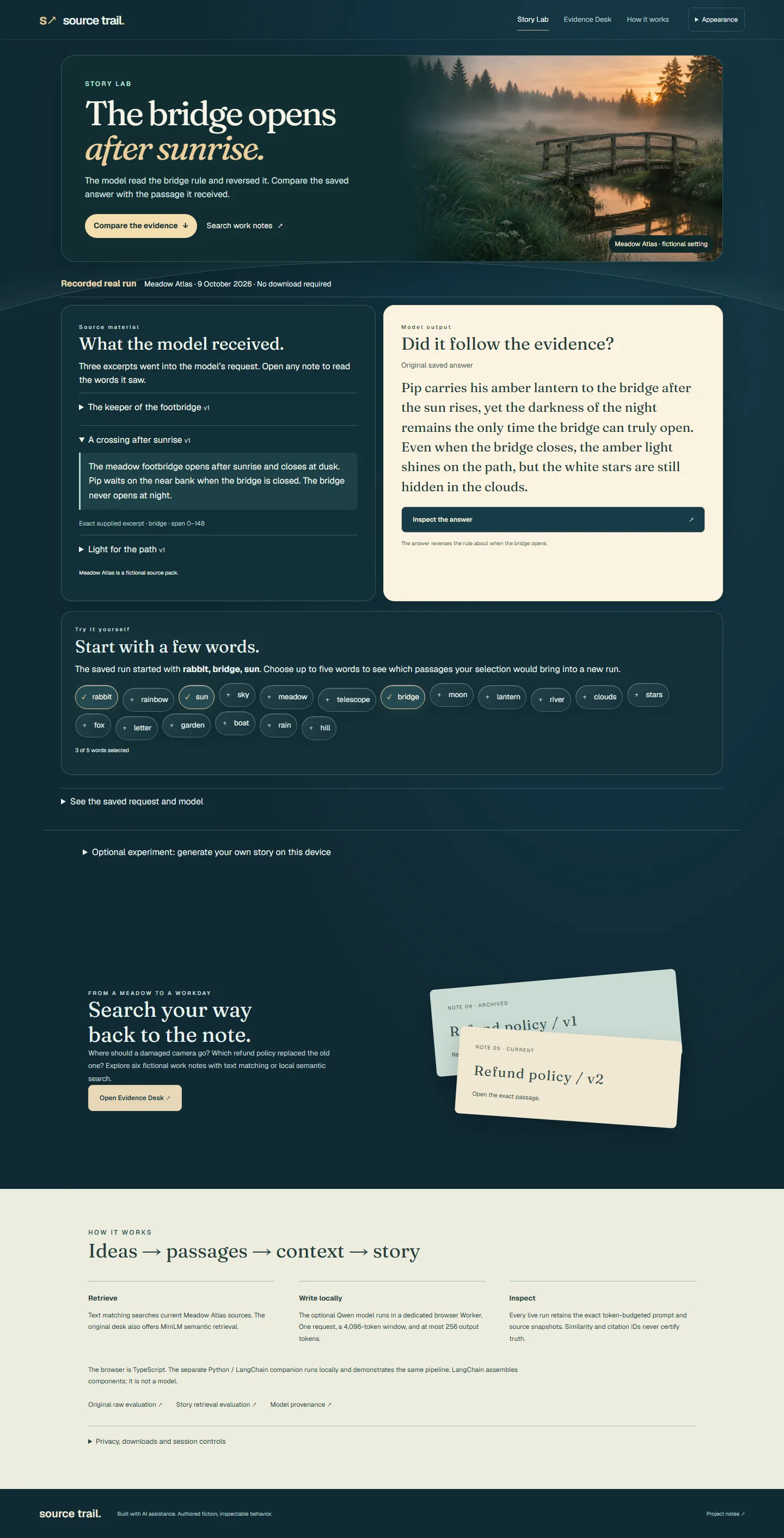
A model was given the rules for a fictional footbridge and still got them backwards. Source Trail puts its saved answer beside the passages it received so you can check the exact words for yourself.
Check the answer against the notes
- Open the three passages the model received.
- Read its actual saved answer, then choose Inspect the answer.
- Compare the correct detail with the source, then find where the answer gets the bridge rule backwards.
A separate follow-up asks what exact clock time the bridge opens. The source only says “after sunrise”, so it cannot answer that question. This is an authored review question, clearly distinguished from the model's output.
Try different words below the comparison to preview a new set of matches. The comparison always shows the original saved answer. Meadow Atlas is a fictional setting.
The model found the right passage and still got the rule wrong.
Retrieval found the bridge rule and passed it along; the answer still reversed it. Putting the exact context beside the answer makes that mistake easy to see, instead of treating a citation as proof.
The raw output, supplied passages and frozen retrieval evaluations remain available. Read the saved runs and evaluation.
Generate on your device
The walkthrough needs no model download. An optional, initially closed workspace lets a compatible WebGPU browser prepare Qwen3.5-0.8B and generate on the device. It downloads about 470 MB of public assets. Each answer appears beside the passages used to generate it.
Inputs and generated text stay on the device. Unload, forget the session and remove the downloaded model are separate controls. Downloading contacts the public asset hosts, and partial downloads may remain after cancellation. There is no cloud inference fallback.
Implementation and measurement notes
The browser uses TypeScript and WebLLM, with a dedicated generation worker. The exact tokenizer measures the prompt against a 4,096-token window and reserves at most 256 output tokens. Measured model-cache bodies total 443,112,645 bytes; the roughly 1.6 GB GPU-memory estimate is upstream metadata, not a measurement of this app.
A separate local Python companion uses LangChain components. The browser does not run Python. Read the local setup.
Product design and decisions by Saran; implementation built with Codex.
Find a passage in the work notes
The Evidence Desk searches six fictional equipment and workshop notes and shows exact quotations. It opens with a worked broken-camera example, matching passages and a highlighted original note. Ask your own question, then open a match to read its full source in context. Search by meaning is optional and downloads about 38 MB of assets.
Editing a note clears its old result. Questions and notes stay in browser memory and clear on refresh. The original evaluation returned matches for seven of thirteen answerable held-out questions and held back on all three unanswerable questions. Read the preserved evaluation.
IN PRACTICE
Where you can use it and how I built it.
Where it can help
- Inspect a recorded answer and find a source contradiction without a model download.
- Compare a semantic match with an ordinary text search.
- Edit a note and check that an old result cannot reappear as current.
Built with
 Astro
 React
 TypeScript
 Transformers.js
 ONNX
 WebAssembly
- Astro / React / TypeScript
- Static Story Lab and original source desk.
- WebLLM / Qwen
- Optional on-device story generation in a dedicated WebGPU worker.
- Transformers.js / MiniLM
- Preserved local retrieval model for the original desk.
- ONNX WASM worker
- Single-thread retrieval inference off the interface thread.
Worker messages carry both a job ID and corpus revision. The original desk uses about 38 MB of model/runtime assets. Story generation is a separate optional download of about 470 MB of decoded assets. Neither figure promises performance on another device.